Why preserving muddy peatlands matters more for the climate than planting billions of trees
March 27, 2026
The popular imagination holds a deeply ingrained image of climate salvation centered almost entirely around endless rows of freshly planted saplings spreading across a greening Earth. Corporations, governments, and philanthropic organizations alike frequently pledge to plant millions, even billions, of trees to offset their carbon footprints and restore the natural balance of the atmosphere. The concept feels intuitive, visible, and deeply reassuring to a public anxious for tangible environmental action. Yet, this intense and heavily funded focus on global afforestation often masks a surprising reality about how the planet actually breathes and regulates its temperature. The assumption that sprawling new forests represent the absolute apex of carbon storage ignores an entirely different, infinitely less glamorous ecosystem that has been quietly hoarding the world’s carbon for millennia.
This crucial landscape consists largely of wet mud, decaying moss, and stagnant water. Peatlands, which cover barely three percent of the global land surface, store roughly twice as much carbon as all the world’s forests combined. Data compiled by the United Nations Environment Programme has repeatedly highlighted this stark contrast, showing that these waterlogged bogs contain centuries of undecomposed organic matter safely locked beneath the surface. Across the vast stretches of the northern hemisphere, including Canada, Scandinavia, and Russia, as well as in dense tropical zones in Southeast Asia and South America, peat terrains hold unfathomable reservoirs of greenhouse gases. When people look at a sprawling, muddy moorland or a flooded swamp, they rarely see a climate savior. However, the scientific consensus firmly dictates that these dense, squishy terrains are the most efficient terrestrial carbon sinks on Earth.
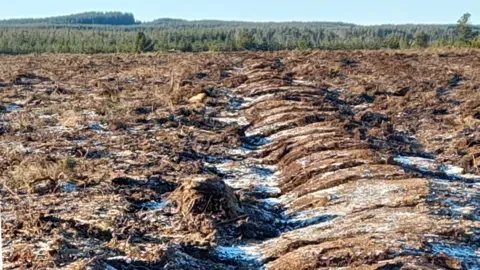
The mechanics of a peatland explain this extraordinary capacity and reveal why they are so different from standard woodlands. In a typical forest ecosystem, a fallen tree eventually rots, and the natural decomposition process releases carbon dioxide back into the atmosphere in a relatively fast cycle. Peatlands operate under entirely different physical rules. Because the ground is permanently saturated with water, oxygen is largely choked off from the soil beneath the surface. The plant matter that dies and falls into the bog simply cannot decompose fully in this anaerobic environment. Instead, sphagnum mosses, grasses, shrubs, and tree roots slowly compress over thousands of years into deep, dense layers of peat, effectively burying the carbon. However, this ancient balancing act is acutely fragile. The moment human intervention alters the water table, the protective spell is broken. For decades, agricultural developers and commercial forestry operations have dug deep drainage ditches through global peatlands to dry out the soil for crops, livestock grazing, and, ironically, commercial tree plantations. Once the water drains away, oxygen immediately floods the deep layers of peat, and microorganisms begin rapidly breaking down the ancient organic material, venting thousands of years of stored carbon straight into the sky.
The consequences of this draining process are staggering and increasingly visible on a global scale. Dried peat becomes incredibly flammable, transforming a former natural carbon vault into a massive environmental hazard. The devastating Indonesian wildfires of 2015 provide a grim, historically significant example of this vulnerability. To clear land for lucrative palm oil and paper plantations, vast tracts of ancient tropical peatlands had been systematically drained. When fires inevitably sparked during an unusually dry season, they did not just burn the surface vegetation; they burned deep underground through the dried peat layers. These subterranean fires are notoriously difficult to extinguish and produce exceptionally thick, toxic smog. Researchers analyzing the 2015 crisis found that during the peak of the disaster, the daily carbon emissions from the Indonesian peat fires actually exceeded the daily carbon emissions of the entire United States economy. Beyond the catastrophic atmospheric damage, the resulting haze caused severe respiratory crises across Southeast Asia, illustrating how localized environmental degradation rapidly scales into an international public health disaster. In Europe, similar historical missteps haunt places like Scotland’s Flow Country, where mid-twentieth-century government tax incentives encouraged landowners to drain ancient bogs to plant commercial conifer forests. The non-native trees struggled to grow in the highly acidic soil, but the deep drainage successfully ruined the bog ecosystem, triggering a massive, sustained release of stored carbon that scientists and conservationists are only now working to calculate and reverse.
Acknowledging these destructive patterns requires a fundamental shift in how global climate finance and large-scale conservation strategies are directed. Planting trees remains a vital component of restoring degraded lands and supporting biodiversity, but it cannot be treated as a blanket climate solution, especially when those trees are planted on drained or compromised peatlands. Environmental scientists increasingly advocate for a massive pivot toward ecosystem preservation and restoration, specifically through a process known as rewetting. By intentionally blocking the old agricultural drainage ditches and allowing water levels to rise back to their natural state, conservationists can swiftly halt the decomposition of the peat and lock the remaining carbon back into the earth. Pilot restoration programs across the United Kingdom, Germany, and Finland have already demonstrated that rewetting bogs can drastically reduce carbon emissions from the soil within just a few years of implementation. Furthermore, international carbon markets and government subsidy frameworks must evolve to place as much financial value on preserving a muddy acre of intact peatland as they currently do on planting an acre of new trees.
The fight against a warming planet demands that society look beyond its aesthetic preferences for pristine woodlands and dramatic, photogenic environmental gestures. It requires a quiet, deliberate respect for the raw ecosystems that have been doing the heavy lifting of atmospheric regulation since the end of the last Ice Age. Accepting the immense power of the world’s peatlands forces a necessary maturation in environmental thinking, one that recognizes that the most effective climate solutions are not always the ones that look best on a corporate sustainability brochure. Realizing the full potential of global carbon storage will require getting our boots wet, protecting the stagnant bogs from development, and allowing nature's ancient, muddy vaults to remain entirely undisturbed.