Trump’s Transactional Foreign Policy Changed the Map Long Before Any Return
April 1, 2026
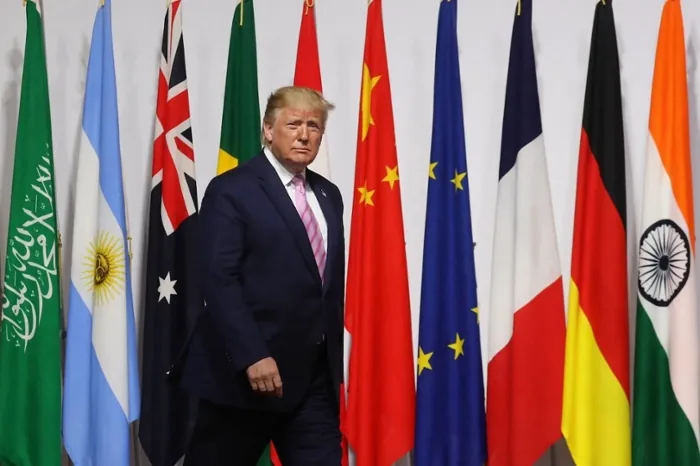
It is tempting to see Donald Trump’s approach to world politics as a noisy interruption rather than a lasting change. That view is comforting, but it is increasingly hard to defend. The deeper story is not just about one presidency or one politician’s style. It is about what Trump exposed: many countries no longer assume the United States will act as a steady guardian of the old order. Once that doubt entered the system, it began to reshape strategy far beyond Washington.
The clearest evidence is visible among U.S. allies, not its enemies. During Trump’s first term, he openly questioned NATO, called for allies to pay more for defense, withdrew from major agreements, and treated long-standing security ties as bargaining chips. Some of those complaints were not new. U.S. presidents from both parties had pressed Europe and Asia to do more. But Trump’s method was different. He framed alliances less as shared commitments and more as transactions. That distinction mattered. In international politics, tone can become structure.
Data from NATO itself showed that after 2014, and then more sharply after 2017, European defense spending began to rise. Russia’s seizure of Crimea was the main trigger, and the full-scale invasion of Ukraine in 2022 accelerated the shift dramatically. But Trump’s pressure also had an effect. By 2024, a record number of NATO members were on track to meet the alliance’s 2 percent of GDP defense target, according to NATO estimates. In Germany, a country long criticized for military underinvestment, the government announced a 100 billion euro special defense fund after Russia’s invasion. That move came under a different U.S. president, but it grew from a larger realization already taking hold in Europe: dependence on Washington had become a strategic risk.
The same pattern appeared in Asia. Trump’s trade war with China was often discussed as an economic fight. In fact, it marked a larger geopolitical turn. His administration’s tariffs, export controls, and hard rhetoric helped solidify a bipartisan U.S. shift toward treating China as a long-term rival rather than a difficult partner. That change did not end with Trump. It widened. The Biden administration kept many tariffs in place and expanded restrictions on advanced semiconductor exports. Japan, the Netherlands, and South Korea then found themselves pulled into a new strategic alignment built around technology, security, and supply chains. What began as Trump’s blunt pressure evolved into a more durable architecture of competition.
This is why Trump’s geopolitical legacy cannot be measured only by summits, speeches, or disrupted meetings. It is better measured by the way governments changed their planning. In Europe, leaders began talking more seriously about strategic autonomy. In East Asia, countries deepened defense ties while also preparing for the possibility of a less predictable Washington. In the Gulf, states such as Saudi Arabia and the United Arab Emirates continued security ties with the United States but also expanded relations with China and kept channels open with Russia. India strengthened defense and technology links with the U.S. while still protecting room for independent diplomacy. This is not old-style nonalignment. It is hedging in a world where even close partners are no longer sure the center will hold.
The causes go beyond personality. Trump gave political form to deeper U.S. trends. American voters were already tired of costly wars. The Congressional Research Service and other public records show the United States spent trillions on post-9/11 conflicts, with enormous human and financial costs. Trade politics had also shifted. Many communities in the U.S. believed globalization had brought job losses and weak bargaining power. Trump did not create those frustrations. He weaponized them. His message to the world was simple and unsettling: American power would be used more narrowly, more conditionally, and with less respect for old diplomatic language.
For rivals, that message created openings. Russia tested Western unity. China increased pressure around Taiwan, expanded naval activity, and deepened its global economic footprint through trade, lending, and infrastructure links. Neither country became dominant because of Trump alone. But both benefited from a period in which the reliability of U.S. commitments looked less automatic. Research from the Chicago Council on Global Affairs and Pew surveys across allied countries repeatedly showed concern during those years about trust in U.S. leadership. Confidence can be hard to measure, but once it drops, governments react. They buy more weapons. They diversify suppliers. They sign backup deals.
The consequences reach beyond ministries and military budgets. When alliances weaken or appear uncertain, ordinary people pay the price. Energy shocks become more severe. Supply chains become more political. Smaller countries face stronger pressure from larger powers. Ukraine is one vivid example of what happens when revisionist states believe Western resolve may crack. Taiwan sits under a similar shadow, though under very different conditions. In both cases, the daily lives of millions can be shaped by strategic calculations made far away.
There is also a domestic consequence inside democracies. Trump’s style encouraged the idea that foreign policy can be reset quickly, almost like a branding exercise. In practice, international trust does not work that way. Allies can adapt to a hawkish America or a restrained America. What they struggle with is a swing state superpower, one that can move from treaty language to public threat in a single election cycle. That uncertainty raises insurance costs for everyone. It pushes partners to spend more, duplicate systems, and prepare for political shocks instead of shared strategy.
If there is a lesson here, it is not that allies should simply wait and hope for a return to old habits. The old model is already gone. European states need stronger defense capacity that complements NATO rather than competes with it. Asian allies need clearer burden-sharing and more regional coordination. Washington, for its part, needs to decide what it wants alliances to do and then say so with consistency. Demands for fairer burden-sharing are reasonable. Public threats to collective defense are not. Strategy works best when partners know the price of failure and the value of commitment.
There is also a need for honesty in the public debate. Trump did not invent every problem he exploited. Some alliances had grown complacent. Some trade rules did produce sharp local pain. Some U.S. interventions did overreach. But exposing weakness is not the same as building strength. The real test of statecraft is whether it leaves a system more stable than before. On that measure, Trump’s geopolitical impact remains profound because it loosened a basic assumption that had guided the post-Cold War world: that American leadership, whatever its flaws, was ultimately predictable.
That assumption may never fully return. Even if future presidents speak the language of reassurance, allies and rivals alike have seen the warning light. They now know that U.S. policy can turn inward, become personal, and place a price tag on principles once treated as fixed. In geopolitics, that kind of knowledge does not disappear. It lingers in defense budgets, trade routes, election fears, and war planning. Trump’s foreign policy was not just a phase in global politics. It was a stress test, and the world is still living with the results.